Showing posts with label Custom Bra. Show all posts

Thursday, January 25, 2018

Sewing Bras - Custom Drafting a Strapless Bra Part 3

Welcome to part 3 of my custom draft strapless bra!  [Check out Parts 1 HERE and Part 2 HERE]

IT IS DONE!


Feels sooo good to have finally finished it.  Well, mostly finished - I'm still waiting on some more black hook and eye tape but the white I put in temporarily will suffice for now.


The color combo didn't quite turn out as I had hoped but is fine for a serviceable strapless bra.


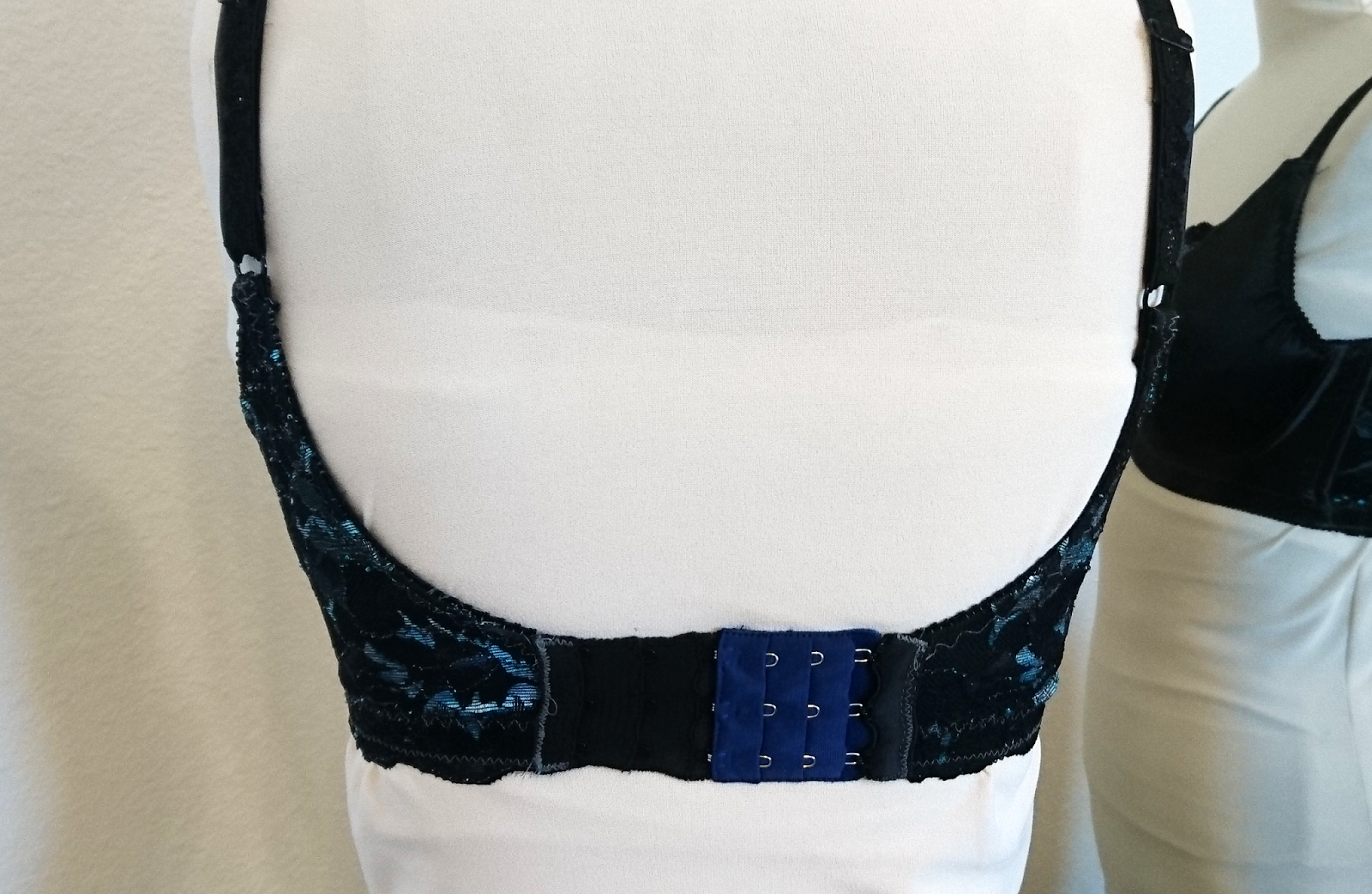
Check out that lace!  I wanted some continuity between the front purple section and the back black powernet.  Stretch lace placed on the diagonal did the trick!

This bra was definitely a labor of love.  There were challenges and quite a few firsts all around.  This bra features 4 bones in the band and 4 bones in the cups.  I added self made cookie inserts and sewed them to the cup in a free floating fashion.  The cups themselves had dual layers of foam - to ensure a smooth exterior despite all the boning.  I also had to shorten the U shaped or Strapless underwires a smidge (1/4") at center front to make it fit.  Band feels a bit loose to me and more secure on the tightest set of hooks.  Silicone elastic across the top of the back band would have helped immensely (I had 3/4" regular plush elastic or 1/2" silicon - I erred on the 3/4").


LESSONS LEARNED
- If adding cookie inserts, make them removable next time.   If for no other reason than to avoid sewing through 4-5 layers of bra foam.
- If adding inserts for more push up, lower the height of the upper cup (even more).  Possibly curving it a bit higher towards the arm pit. Current cups + 4 layers of foam (4 for the inserts and 2 for the cup) = slight quadding. Zero quadding without the inserts.
- Consider adding another set of boning in the back band over the powernet.  This will likely need to use channeling to allow the bones some movement.  Previous experience sewing boning on powenet was less than spectacular.
- Consider reinforcing the top edge of foam cup with tricot or similar non-stretch material - hopefully this will help resolve the rolled edge issue.
- Use higher quality plush elastic or just FIRM plush elastic as quite a bit of the support comes from the band.

POSSIBLE EXPERIMENTS FOR NEXT ROUND
- Shorten the u-shaped wires even more (evenly on both ends AND/OR shorter in center front). Maybe another 1/4" off each end?
- 1/2" Silicon backed plush elastic.  The concern with this one is the difference in elasticity.  I've found I need a fairly firm elastic for the upper band elastic to spring the wires correctly.
- Possibly shorten the back band 1/2" to account for the extra stretchy plush elastic (I bought 50 yards of this stuff that stretches almost 100%!!)


Overall, I'm very pleased with how this turned out!  Fit is pretty darn good if I do say so myself.  My issues at this point are all very minor.  Hooray!


Friday, January 12, 2018

Sewing Bras - Custom Drafting a Strapless Bra Part 2

A quick update on my Strapless Bra drafting adventures.


Since my last post, my fitting problems were as follows:

#6 - cups are no longer pointy but tilt downward toward the armpit despite ensuring marks on the cup lined up with the marks on the cradle. Needs to be taken in a smidge at the cross seam near center front.

#7 - bra band is ridiculously huge.  It measured 30" unstretched - and that included a 12.5% negative ease for the elastic (which incidentally, I apparently pickup that percentage out of nowhere)


I had finished redrafting the bra band to better suit my tastes last round.  The fit is significantly better with 2 caveats.  1) The elastic I am using is much too stretchy despite being 3/4"!  It stretches 100% easily.  2) The single layer of powernet may not be enough for what I am looking for.  Will entertain doubling the powernet.

#8 -  tilting the cups within the frame too see if it would be enough to off set the odd angle.  

The cups pointing downward (like a sad puppy) was quite vexing.  After a good night's sleep, I tried on the bra again and noticed a few things I didn't previously. The bridge was too wide near the top and too narrow near the bottom.  AHA!  I had forgotten about the ONE alteration I always make to bra patterns as it is a necessity in order for the bridge to fit properly. Goodness I felt silly.

#9 - took in the center gore at the correct angle for my typical adjustment.

AAAAND.  Still sad puppy cups.  I had to step away for the rest of the day.  

During my break from sewing, I got to thinking about Natasha's Underwire Theory [link HERE] on her blog.  Specifically she talks about the importance of accounting for wire spring when drafting.  While she doesn't walk you through all the steps of how to draft the bra bridge, the focus on wire spring included a different way to account for it as well as thorough explanations that I found extremely helpful. The most important lines I found was this:


"... a wire should be sprung 15mm and while this seems to be commonly repeated I have found through further education and experience that 15mm is not necessarily a rule. In many cases, it is the minimum amount of wire spring that should be added and it is possible to add up to 55mm of wire spring." - www.bramakingblog.com


compared to:


"Test the amount of splay in the wire by holding the front arm of the wire and flexing the side outward. Make a note of how much it splays. Trace the wire and then pivot the wire back the amount of the splay toward the side seam, using the bottom of the curve as a pivot point. Trace the new curve and use it for your bra draft. " - Bra-Makers Manual Vol 2.


In essence, they are both stating the same thing.  Bras need a little extra space in the channeling to account for the wire spring.  Wire spring can differ depending on the size(length) of the wire.  It would have helped my case IMMENSELY if the BMM had stated a 15 mm (smaller cups) and 55 mm (larger cups) as examples.   I would have realized that my spring of 5 mm was much too small.

Here is the result of drafting with too small a spring vs the 15 mm.


The overall curve is flatter with the 15 mm vs the 5 mm as one would expect.  However, it also LOWERS the overall height.  In my case, a wire spring (using a U-Shaped wire)  of 5 mm results in a center gore that was TALLER than the underarm - causing the droopy sad puppy eye cups!!!  Hallelujah!


Green line is perpendicular to center bridge - note how one side is taller than the underarm side.

So, I think we're finally ready for some real lingerie fabrics and lace!  Many thanks to Natasha and the fabulous people on the Bra Making Forum!  This has definitely been my biggest bra making challenge yet!

Monday, January 8, 2018

Sewing Bras - Custom Drafting a Strapless Bra

I know its been quite a few weeks without any bras - I'm finally ready to give a peek on what I've been working on.


I want/need a long line strapless bra as I do not have any in my current size.  I use the term "long line" loosely as the name changes depending on the manufacturer, style, and even era.  To clarify, it is a bra that extends at least to the waist - I am prefer the type that ends at the hips. Like these.

Aren't they gorgeous?  [From L to R] What Katie Did Glamour Noueveu, Warner's Merry Widow from 1957 and Cabaret Torsolette 


That said, my first FEW attempts were pretty sad. Having made corsets before, I approached drafting the bra similar to corsets. Call it idiocy, call it over confidence, but it didn't occur to me to read over the section on Strapless bras in my favorite bra making book.  The results were as one would expect.

#1 - Waist too big.  Took a wild guess on % of reduction for the elastic. (I did 5%)
#2 - Fixed waist, cups sagged, wrinkles at the center gore, boobs had zero lift and
#3 - Inserted U-wires.  This helped the cups retain some shape better but also were too long for the band.

This lead me to try drafting my own - properly.

Using the Bra Maker's Manual Vol 2, I was able to follow instructions and draft the band and lower cup without a problem.  The upper cup directions was less so. At one point, I contemplated asking my husband to read the passage and see what he came up with.  Ultimately, I succeeded on my own by looking at the diagrams and ignoring the directions!  Then just needed to repeat all the steps for the other cup.  I wasn't sure if it was even necessary as the cross cup measurement were different by half inch.  Thinking I could probably use the practice anyway, I went ahead and drafted upper and lower cups for each breast.  Its interesting to note the differences in pattern shape and size based on a difference of 1/2 inch!  It took me 2 days but drafts are done!  Not too bad as I was attempting this with my littles running around high on life.

Not wanting to COMPLETELY start over and waste perfectly good materials, I decided to sew up the bridge of my new self draft and OVERLAY it onto my in-progress strapless bra.  On the same wavelength, I had hoped to reuse the bra cups, cut according the new pattern and re-insert.  As expected, more issues arised.

#4 - cups are comically huge and pointy, wires do not spring (I do think this may be due to the elastics not being completely sewn on?)

It seems my NEW problems stem from measuring!  Perhaps this is why they don't recommend working late into the night!  That and my particular body type doesn't yield a visible IMF near the arm.  No amount of poking or prodding could produce a semblance of a fold to measure the cross cup seam. In the end, I had to wear a bra and measure based on the indention the wire created when I took it off.  Or just measure over a bra (not an option for those with my body type AND no well fitting bra!)

So after remeasuring, re-drafting and pattern creating, I test out my custom bra cup pattern ver 2.

#5 - cups are MUCH closer to being a real fit, but still pointy
#6 - cups are no longer pointy but tilt downward toward the armpit despite ensuring marks on the cup lined up with the marks on the cradle.

In order to address the tilt issue, I decide I MIGHT need to actually make a full strapless bra based on the pattern I drafted.  Thus, I take the cups out of the strapless long line, sew up the band of my custom draft and throw it on.  Another COMICAL situation.

#7 - bra band is ridiculously huge.  It measured 30" unstretched - and that included a 12.5% negative ease for the elastic (which incidentally, I apparently pickup that percentage out of nowhere).

This maybe more of a personal preference than mistake.  My underbust measures 29" tight and 30" snug.  Evidently I am accustomed to wearing my bra bands pretty tight.  Perhaps it was from my years of wearing Victorian Corsets (off and on) for years. This was evident when I measured my underbust again - this time, while wearing a bra - and measured 29". [***Details Below ***]. Cue more drafting.

Aaaaand this is where I currently stand. Three days of proper bra drafting, testing, redrafting and more testing (not including the days where I worked on the Strapless Longline/merry widow/bustier even before cracking open my books!).  Currently on version 2 of the band, version 4 of the cups, and version 2 of the merry widow.  We will see what the next few days bring.  Thank goodness for water soluable thread!


 ----------------------------------------------------------------------------------------------------

*****For those who may also run into this type of problem on their first foray into custom bra drafting, I took note of the finished (unstretched) band lengths of my RTW bras for comparison.  My best fitting bras all had a 32 band that physically measured approximately 26.5" unstretched.  With the 26.5" as a reference, I still had to decide the % of negative ease for the elastics.  This percentage is dependent on the stretch factor of the fabric used for the back band.  In my case, a single layer of powernet had 50% stretch (5" stretched to 7.5").  The Bra-Makers Manual says to reduce no more than 1/2 and ideally only 1/3 of the length (or anything within that range). So I do a few quick calculations to get some comparisons based on my 7.7" pattern piece.

25% reduction (1/2 of 50% stretch) = 1.81" x 2 (wings) = 3.6" => 25.4" total length
16.6% reduction (1/3 of 50% stretch) = 1.2" x 2 (wings) = 2.4" => 26.6" total length

And just out of morbid curiosity, how much I would have needed to stretch on Ver 1 of my pattern with 7.75" piece:

25% reduction (1/2 of 50% stretch) = 1.94" x 2 (wings) = 3.875" => 26.125" total length
16.6% reduction (1/3 of 50% stretch) = 1.29" x 2 (wings) = 2.6" => 27.4" total length

These numbers confirm what I have suspected for a while.  The smaller the band size, the less "squish" one has to tolerate a firm band.  This is due to the smaller bands having less fabric and thus less stretch.  You can easily test this theory by stretching a piece of 5" elastic (or powernet) to its max. Then repeat with a piece of the SAME elastic that is only 2.5".


Tuesday, November 7, 2017

Sewing Bras - Designing a New Style Based on a Well Fitting Pattern (aka Block)

Now that the Costume Season (aka Halloween) is over, lingerie sewing has resumed its full course. Yay!

In my pursuit to further my (bra) education, I've decided to try out a new style with different materials.  As I am not quite ready to completely draft my own patterns from scratch, using a well fitting pattern (aka Block) seemed like a step in the right direction.

I really liked this style of bra: integrated powerbar/lower cups with strap tab with small section of lace upper. Add a few minor tweaks to suite my particular preferences (lower center gore and foam lower cups) and its perfect!
[Cleo Lucy, Gorsenia Marlene, and Freya Arabella]
As I already had a great fitting foam bra pattern (my fabulous Comexim copy - details Here), I used it as my block.  Following the directions from the Bra-Makers Manual (Vol 2) by Beverly Johnson, I ended up with this:


Basically taking the curves off, draw new lines then add curves back on. [You can see a bit of this in action on Erin's Blog Here] A quick muslin (just one cup) then basted into my test band, and we were ready to for final adjustments.

Here's the final!  I'm super spiffed.


THE PROCESS

I cut out the lower cup pieces in cut-and-sew foam and identical pieces in my fashion fabric.  The satin-y material is wonderful under fitted clothing. For the upper pieces, I used a stretch lace from Trim Expo during my last foray into the Fashion District (Nice selection, great prices!). Then cut the same pieces in bra tulle for the lining.  Since I wasn't using a pattern with accompanying instructions, I assembled the pieces together in the order that made the most sense to me. Zig zag foam pieces together then sew lower cup fabric pieces together. Baste tulle and lace together, add tiny elastic for neckline, sew combined upper cup piece to combined lower cup pieces.  Sew just the strap tab portion of the fabric to the foam (right sides of fabric to wrong side of foam) then flip open. With wrong side of fabric facing up (and right side of foam), overlap the fabric and foam a few mm and sew INSIDE the seam allowance.  Flip over and top stitch on the cross seam.  Pin down lower edges of fabric to foam and baste.  Finish as usual.

A few minor tweaks to the band - added a gothic arch and doubled up on the power mesh in the back.  Also some adjustments to accommodate the lace on the back band.


THE FIT

I am pleased to report it fits! [with caveats].  Cups fit wonderfully - a little too good as this is definitely a push up bra w/ lots of cleavage.  Since I used the Comexim pattern, the girls are lifted and centered without the help of any additional padding or internal slings!  The gravity defying shape was created by relatively FLAT cups (the cups gain shape when they conform to the underwire) - contrary to everything I've read about bra making thus far.  Immediate projection at the wire is non-existent - this would normally cause major fitting issues for me but not in this time! The bust point of Comexim bra cups tend to be above my bust point (I believe this is by design) and was also perfect for this particular re-design.


THE PROBLEMS

My myopic focus on the cups had caused some oversight on the band.  1.) I had raised the height of the wide wings (for that super sleek silhouette I crave) but had forgotten to raise the back band as well.  Thus the band only has 3 hooks in the back, caused some lumps and bumps. 2.) I had also doubled the powermesh for the back band AND added stretch lace resulting in significantly less stretch.  Thank goodness I had one of those bra extenders handy! 3.) The shorter back band also made the back straps too far apart. Sigh.


Overall I'm very pleased.


Monday, August 21, 2017

Sewing Bras - Copying My Favorite RTW bra!

It's finally finished! This gorgeous blue and purple bra got put on the back burner as I excitedly sewed up the Pin-up Girls Classic Bra and awaited the arrival of different underwires.

Look at those fabulous colors!

I'm loving how everything turned out!  Mirroring the fabric was a labor of love as the original fabric included pixilated gradations from green to blue to purple.


At anyrate, a quick run down of how I copied my favorite RTW bra.  After stalking Beverly Johnson's (aka The Fairy Bra Mother) blog, she had mentioned "pin copying" the seams [link here] on your favorite bra to get the basic patterns.  I had attempted to copy this particular bra before and thought I had a pretty good approximation but this is variation yielded MUCH better results.  [Previous attempt here] And with fewer revisions. Actually, I haven't needed to do any alterations yet.

Steps amount to placing paper over foam board/cardboard.  Place bra on top of paper - making sure the paper is large enough to pin copy the pieces on to.  I started with the smallest piece - inner bottom cup.  Use a few pins to "stretch" out the corners and curves.  Then use a pin to "trace" around the seam lines like you're a cheap tattoo artist.  Remove and repeat on an different piece.  For longer pieces you may need to pin out half of the piece, "trace" with pin, remove most of pins leaving the ones near the center of that piece.  Then pin the other half of the piece and finish "tracing" the piece with the pin.  Trace the dots and true the lines.  Your patterns pieces are ready!

Here are my results!


In this particular case, while i did trace the bridge and back band, I used my go-to pieces.  A heavily altered cradle and back band from the Maya bra.


A close up on the pleat detail.  Here's the link for the methods I used from Beverly's blog.


A full coverage, ballet style back band with 4 [four!] rows of hooks/eyes.  The higher sides and back ensure a smooth silhouette.


Here's my version vs the original.  What do you think?


Friday, August 18, 2017

Sewing Bras - Pinup Girls Classic Bra Pattern

Yay! My order from Bra Makers Supply came in! In addition to their very popular Classic Bra Pattern, I also picked up the Bra-makers Manual volume 1 and 2.


Feeling brave after reading the thorough instructions and hearing about all the great reviews about this pattern, I decided to sew it up without making a toile first! It's SOO nice to read sewing instructions that are not only well written, but geared toward beginners. Although I've sewed a half dozen bras already, the methods I used were gathered haphazardly - a few sew-alongs, an online video, random  Google searches on specific techniques. I can definitely see why so many people recommend this pattern as their first foray into sewing underwire bras - makes wonder why I didn't choose it myself.  There is something to be said about paying for a well made sewing pattern and the accompanying instructions. Nevertheless, the tidbits helped improve my sewing - creating neater stitches and more refined workflow.


BRA SIZE
I did a bit of research to see how others chose their size as the size recommended using the instructions yielded 32A... It gave me chuckle as I haven't been a true A cup since high school. After stalking her (Beverly Johnson's) blog, I found this link. She discusses the 4 common ways to measure for bra size, as well as their pro/cons. While she uses the underbust/overbust method most frequently, she freely admits it doesn't work well for petite women. She did mention that the  Bottom Cup Depth method is the most accurate and I agree with this. Luckily, the BCD measurement yielded the same bra size as the ABTF calculator in my case - now a 32E (post weaning).

CONSTRUCTION AND ALTERATIONS
The bra sewed up pretty quickly - no  linings or lace to fiddle with -  and true to unlined bras, easily showed you where adjustments needed to be made. Initially, it looked like there was too much projection the cups as the apex wrinkled but seemed to fit everywhere else. I had started pinning to reduce the projection when I remembered something from Beverly's Manual about taking in just the bottom cup depth.  A few pins later, the cups fit!  I think this particular method only works with my particular body type though. The only other alternation I had to make was taking a wedge out of the bridge under the arms. I found this change to harder to transfer to my  pattern than the others but thankfully the Manual had instructions for that too.

Picture of my super quick ALL BASTE STITCH tester in Simplex

FIT
It fits pretty well! The center gore is a hair too narrow - my fault as I just eyeballed the amount I needed to take in since it's pretty much need to take it in for all bras. Cups are pretty spot on after taking in the the lower cups only.  Still scratching my head on that one a bit - I've been TOO projected for many RTW unlined bras so this is a change. The dart I inserted in the  bridge could stand to be taken in a smidge more as well. Band is stretchier than I would like - the 32 fit more like a 34 as I have them on the tightest hooks. But that's an easy fix. I may double up on the medium powernet or just shorten the band next time.  Straps are pretty comfy and STAY on despite my sloped shoulders.

CONCLUSION
The Pin-up Girls Classic Bra Pattern is an excellent first (or second, third or sixth) underwire bra pattern.  Instructions are thorough with pictures and the patterns themselves are organized in a way that is easy to find.  While the full coverage style itself isn't earth shattering, it does make fitting easier and a well-fitting bra will beat a cute ill-fitting one any day. I forsee this pattern translating well into a nursing bra, demi cup and foam cup versions and for the intrepid, a sport bra (with the help of the Bra Makers Manual).

Friday, July 14, 2017

Sewing Bras - Adjusting Your Custom Bra to Your Liking

 Custom Bra attempt #3 (or bra #5 in the grand scheme of things)!

After my last round of attempting to copy and merge various elements from two RTW bras with some minor adjustments, I (surprise, surprise) discovered I needed more adjustments!  

Adjustment #1 - My bright idea of moving in the straps 2 cm seemed to flatten me out.  I believe it has to do with the combination of the style and possibly the materials. The material I used for the foam lining is notably "softer" than the original thus slightly less structure?  In a different style that is more "natural" and/or unlined, moving the straps 2 cm shouldn't make that much of a difference.  Oh well.  Lesson learned.

Adjustment #2 - In order to better mimic the RTW bra, I decided to try an "external" power bar.  Incidentally, the RTW bra had both padded "internal" (inside the cups) and "external" (outside the cups) power bar!  I had assumed the exterior power bar was for visual appeal only.  How wrong I was! The power bar helps brings the girls up and center better than the bra alone.  Even with higher side wings (more on that below).  I lined up two of the outer cup pattern pieces to draft the power bar pattern as a starting point.  Since the power bar was going to be made of stretchy material, it didn't have to be exact.  I took my lightweight powernet (only type of powernet I had at the time) and folded it over so it was double layered and cut while lining up the fold on the straight edge.  Then I cut a matching set in the last bit of matching lace I had.  Zigzagged the three layers together with a bit of lingerie elastic and it was ready to attach to the main bra.  The main portion of the bra was already complete at the point and I was feeling lazy, sooo... I just sewed it on to the cradle of the bra following the stitches from the wire casing.   Same with the portion of the cups to the straps.  It made it kinda bulky but did the job!

Adjustment #3 - By far the easiest adjustment with minimal issues, I went ahead and raised the height of the side wings a full inch.  Its still not quite as high as the RTW bra I have, but a bit more comfortable while still keeping a smooth silhouette.  [If you're wondering why in the world I would want to raise the side wings, check out my review on Satami bras!]

Adjustment #4 - I decided to try my hand and adding lace detail that didn't have finished edges.  It requires lots of zig zaging in different angles but thankfully, I have some free hand embroidery experience.

Overall, I'm pretty pleased with the end result!  The bra lifts and "shapes" as I had hoped.  It creates a rounder profile, which I prefer, and brings the girls closer together.  My boobs have never felt better.  No more settling for ill fitting RTW bras where the center gore is too wide [so its sitting on breast tissue], too tall [so its jabbing me in the chest], narrow back bands [causing back rolls, ugh], and my arms rubbing against my boobs when driving [I'm narrow set but they point wide].  I felt good enough about the bra to make a pair of matching panties late into the night.  The pattern is based off the highly rated Merckenwaerdigh Mix 30.

I highly recommend trying to sew your own bra if you tend to have issues with most RTW bras.  You can purchase bra making kits for less than cost of a full price bra at Nordstroms.  Try out the FREE Maya Bra pattern from AFI Atelier (check out my review on them here) and/or take a look at the instructions.  If you have ANY experience sewing, try it out.  If you have zero experience with sewing but NEED pricey bras (cuz small band + large cups = $$$$), it may be worth your time and effort to learn to sew!  With bra making kits at the same price as a new bra, what do you have to lose?

Recipe - Keto Fresh Orange Cranberry Muffin Recipe

After a VERY long break, we're back!  We're re-dedicating this blog to all mommy related things - minus the bra making track.  Bra m...